Federal Income Tax Brackets (2026): How Marginal Rates Actually Work
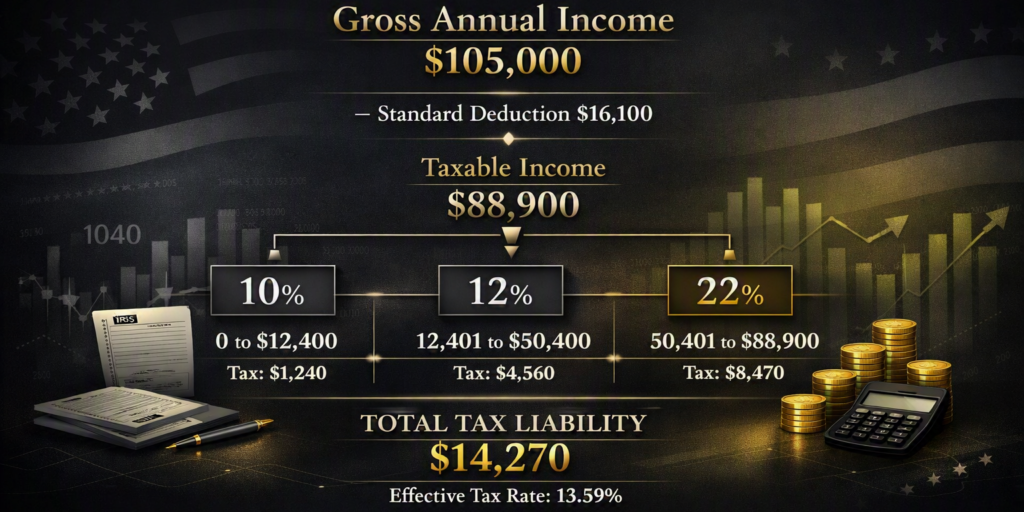
A single promotion or end-of-year bonus will never reduce your net home pay due to moving into a higher tax bracket. The underlying system operates through a progressive structure, applying rates to incremental slices of income rather than taxing total earnings at one uniform percentage.
Gross Annual Income
Taxable Income
Slice 1 (10%)
$0 to $12,400
Tax
$1,240
Slice 2 (12%)
$12,401 to $50,400
Tax
$4,560
Slice 3 (22%)
$50,401 to $88,900
Tax
$8,470
Total Federal Tax Liability
Effective Tax Rate: 13.59%
Understanding how the Internal Revenue Service (IRS) divides your earnings across these thresholds prevents costly financial missteps, such as rejecting overtime or unnecessarily delaying revenue to avoid imaginary penalties.
Marginal Rates vs. Effective Rates: The Core Distinction
Confusion often stems from mixing up your marginal tax rate with your effective tax rate. Your marginal rate represents the tax percentage applied to the very last dollar of taxable income earned. Your effective rate reflects the actual percentage of your total income paid to the government.
When a single filer earns $88,900 in taxable income during 2026, they enter the 22% marginal bracket. That does not mean the IRS collects 22% of $88,900 ($19,558). Instead, the tax builds in progressive layers:
- The first $12,400 is taxed at 10% ($1,240).
- Income from $12,401 to $50,400 (a $38,000 span) is taxed at 12% ($4,560).
- Only the remaining income above $50,400—specifically $38,500—is taxed at 22% ($8,470).
Combining these tiers results in a total federal liability of $14,270. Dividing $14,270 by total income ($105,000) yields an effective tax rate of roughly 13.59%.
Before applying these bracket calculations, you must calculate your baseline tax liability by subtracting allowable adjustments and standard deductions from total gross income, as outlined in how taxable income is calculated.
2026 Federal Income Tax Brackets and Thresholds
The IRS indexes tax brackets annually to prevent "bracket creep," where inflation pushes taxpayers into higher brackets without real gains in purchasing power.
The baseline structure maintains seven progressive tax rates: 10%, 12%, 22%, 24%, 32%, 35%, and 37%.
Federal Tax Brackets & Rates
| Tax Rate | Single Filers | Married Filing Jointly | Head of Household |
|---|---|---|---|
| 10% | $0 to $12,400 | $0 to $24,800 | $0 to $17,700 |
| 12% | $12,401 to $50,400 | $24,801 to $100,800 | $17,701 to $67,450 |
| 22% | $50,401 to $105,700 | $100,801 to $211,400 | $67,451 to $105,700 |
| 24% | $105,701 to $201,750 | $211,401 to $403,550 | $105,701 to $201,750 |
| 32% | $201,751 to $256,225 | $403,551 to $512,450 | $201,751 to $256,200 |
| 35% | $256,226 to $640,600 | $512,451 to $768,700 | $256,201 to $640,600 |
| 37% | Over $640,600 | Over $768,700 | Over $640,600 |
2026 Standard Deductions
Brackets apply only to taxable income. The standard deduction reduces gross income before brackets take effect:
- Single: $16,100
- Married Filing Jointly: $32,200
- Head of Household: $24,150
A single taxpayer earning $65,000 in gross salary subtracts the $16,100 standard deduction, leaving $48,900 in taxable income. This places their top dollar inside the 12% bracket, keeping them below the 22% threshold entirely.
Operational Pitfalls: Bonus Withholding vs. Actual Tax Obligation
A frequent point of friction occurs when receiving supplemental income, such as a year-end performance bonus or commissions. Employers often withhold a flat 22% for supplemental wages under IRS guidelines.
This flat withholding rate is an administrative estimate, not a separate tax penalty.
Supplemental Bonus Tax Reconciliation Flow
Supplemental Bonus
Sent Directly to IRS
Real Bracket: 12%
Real Tax: $1,200
Real Bracket: 32%
Real Tax: $3,200
If your marginal rate is only 12%, the payroll system over-withholds by 10%, which returns to you as part of your tax refund after filing. Conversely, if your marginal rate is 32%, flat withholding underfunds your tax obligation, creating an unexpected balance due at year-end.
To navigate how bracket mechanics align with overall tax compliance, review the complete framework in the guide to US individual income tax filings.
Strategic Moves to Control Your Marginal Bracket
Managing your marginal bracket relies on controlling your Adjusted Gross Income (AGI). Lowering your AGI protects lower rates and preserves eligibility for income-phased tax credits.
Strategic Pre-Tax Deductions & Bracket Optimization
Current Gross Income
$110,000Reduced Adjusted Gross Income (AGI)
$104,000- Maximize Pre-Tax Retirement Contributions: Placing funds into a traditional 401(k) or 403(b) reduces gross income dollar-for-dollar. In the example above, removing $6,000 in pre-tax contributions lowers this filer's AGI from $110,000 to $104,000, pulling their top dollars out of the 24% bracket and into the 22% bracket. Because $4,300 of that reduction comes from income that was taxed at 24% and the remaining $1,700 comes from income taxed at 22%, the total federal savings is $1,406 — slightly less than a flat 24% calculation would suggest, since part of the contribution crosses into the lower bracket.
- Utilize Health Savings Accounts (HSAs): Contributions to an HSA lower taxable income while providing tax-free withdrawals for qualified medical expenses.
- Capital Loss Harvesting: Taxpayers holding taxable brokerage accounts can offset capital gains—and up to $3,000 of ordinary income—by realizing capital losses before December 31.
Evaluating marginal tax rates helps you decide whether to direct extra savings into pre-tax accounts or Roth vehicles. If your income temporarily spikes into a higher bracket, pre-tax contributions offer immediate relief. If your income drops, Roth contributions allow you to pay tax at today's lower rate for future tax-free growth.